Today’s post is from Frederick S. Lane, an author, attorney, expert witness, and lecturer who has appeared on “The Daily Show with Jon Stewart,” CNN, NBC, ABC, CBS, the BBC, and MSNBC. His fifth book, American Privacy: The Four-Hundred-Year History of Our Most Contested Right, will be published by Beacon Press in November 2009. For additional information, visit www.FrederickLane.com
 Few addresses have gained so much notoriety so quickly as 133 C Street SE in Washington, D.C. The slim brick townhouse, nestled on a quiet street behind the Madison Building of the Library of Congress, was recently outed as an enclave of fundamentalist Washington insiders by Jeff Sharlet, author of The
Family: The Secret Fundamentalism at the Heart of American Power
Last month, I stayed half a block from 133 C Street while in Washington doing research for a book. It was like bumping into Dennis Kucinich in a DC bookstore (which also happened during my visit); buildings, like people, can take on a weird sense of familiarity when you’ve seen them repeatedly on television or the Internet. As I walked or jogged past the townhouse each morning, it occurred to me that C Street is neatly located at the intersection of my last two books, The Court and the Cross: The Religious Right’s Crusade to Reshape the Supreme Court and American
Privacy: The Four-Hundred-Year History of Our Most Contested Right. The recent spotlight shining through the curtained windows of C Street begs an important question: can we defend a pluralistic democracy from religious zealots without critically wounding core American values, such as freedom of religion and the right to privacy? Not coincidentally, that’s a question that has become particularly pressing since 9/11.

Photo of the C Street house that is home to “The Family,” taken by the author.
So just how far into C Street should the media (or governmental) spotlight shine? The answer lies in a bit of constitutional topology.
In its various decisions on privacy, the Supreme Court has ruled that there is a zone of privacy that surrounds each of us, a zone limned in large part by the rights guaranteed to us in the Constitution. For private individuals, that zone of privacy is a portable sphere that surrounds us and protects us, to varying degrees, from unreasonable governmental interference. But for elected officials, like the Congressional denizens of C Street, the zone of privacy is more like a toroid, or doughnut, hanging around their midsection.
Why the difference? Because before taking office, each member of Congress swears an oath, in which he or she promises to “support and defend the Constitution of the United States against all enemies, foreign and domestic; [to] bear true faith and allegiance to the same; [to] take this obligation freely, without any mental reservation or purpose of evasion; and [to] well and faithfully discharge the duties of the office on which [he or she is] about to enter.” When someone runs for public office, it is understood that the sphere of privacy is going to shrink, often to a discomfitting degree. But there are still aspects of their lives that can and should remain private, which is why the affairs and prayers of Ensign, Sanders, Pickering, and others should not be media fodder (unless, of course, actual crimes are committed — extortion and hush money, for instance — or a leadership vacuum is created while “hiking”). When an elected official swears to uphold the Constitution, however, he or she invites legitimate inquiry into whether his or her core religious beliefs and close associations honor the oath of office, or are aimed instead at subverting the Constitution and depriving non-believers and the non-Chosen of the very rights that make such dominionist or “Seven Mountain” aspirations a possibility in the first place.
In his book and in various articles (such as this recent one in Salon),
Sharlet describes The Family as the nation’s “first fundamentalist lobby,” tracing its origins to anti-New Deal business leaders who worried that Satan carried a union card. But the roots of evangelical lobbying in Washington actually pre-date the New Deal by six decades.
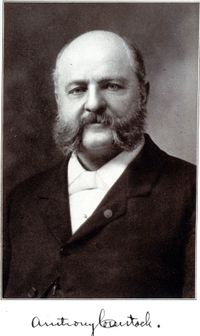 In the years following the Civil War, evangelical business leaders at the New York Y.M.C.A. hired a young man named Anthony Comstock to lobby Congress for a bill to make it a felony to send anything indecent or obscene through the mails. The law also prohibited the mailing of information or items relating to abortion or contraception, any representations that might tend to corrupt youth, or visible writing (i.e., on envelopes or postcards) containing “scurrilous epithets.” Violators could be fined up to $5,000 dollars and sentenced up to ten years at hard labor.
With the active assistance of powerful political patrons (including, for instance, Associate
Supreme Court Justice William Strong, Senator
William Windom [R-Minn.], and Rep.
Clinton L. Merriam), Comstock was appointed as a special agent of the U.S. Postal Service on March 5, 1873, and spent the next 42 years almost single-handedly trying to stamp out indecency, obscenity, abortion, contraception, and scurrilousness throughout the United States.
Comstock experienced some success — he arrested thousands, jailed hundreds, and burned tons of books, pamphlets, photos, rubber items, and other offenders of his sensibilities — but his campaign was intrinsically quixotic. By the time he died in 1915, nude photographs and postcards were well-established, so-called “blue movies” were already circulating through fraternities and fraternal lodges around the country, and couples could whisper sweet (and not-so-sweet) nothings to each other on the new-fangled telephone. Comstock’s influence, however, has lingered: as new communication tools have emerged (radio, television, cable, and the Internet), conservatives in Congress have extended the reach of the Comstock law to cover technologies Comstock himself could never have imagined.
Although Comstock the man has largely faded from public awareness, his dogmatic career should be a cautionary example of how the federal government would be staffed if the The Family and other similar groups get their way: by individuals fired by religious zeal, making decisions informed less by statute than by the Word, and with little or no oversight as they attempt to divine God’s will in the provision of government services and the enforcement of laws against the ungodly and the unsaved. Let’s be clear: Whatever peccadilos and prayers occur in C Street can (and should) stay in C Street; public service does not completely destroy personal privacy. But what is in the hearts and minds of Family members when they publicly swear an oath to uphold the Constitution is not a private matter.


Leave a comment