By Suzanne Kamata
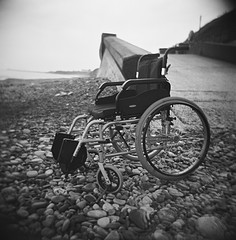 Whenever I case a new location, look at friends' vacation photos, or watch travelogues, I wonder about wheelchair accessibility. I wondered the same thing on Friday afternoon, watching disaster coverage on TV with my eleven-year-old daughter in Japan.
An hour earlier, when I went to pick her and her wheelchair up from school – the school for the deaf, which is housed in an aging four-story building with no elevator – her principal rushed out to my car to tell me to hurry home. He told me that a tsunami warning had been issued for Tokushima Prefecture. Although we live around 500 miles from Miyagi Prefecture, the scene of the greatest devastation, the deaf school is right next to an tributary of the Yoshino River, not far from the inland sea, and our home is just on the other side of the levee. It seemed like a good idea to get away from water.
As I listened to the sirens coming from across the road, warning people to leave the riverside, my daughter and I watched footage of people scrambling up hills as their houses, cars, and livelihoods were washed away. I couldn't help thinking about how hard it would be to get a wheelchair up that hill – and later, seeing photos of the aftermath, of how hard it would be to push through that debris.
It's not especially easy to get around with a wheelchair at the best of times. There are many restaurants near our house that we can no longer visit as a family because they are accessible only by steps. At the local McDonald's, the Happy Meal display blocks the wheelchair ramp, and the toilet stall is too narrow for my daughter and her wheelchair. Last summer, she and I went by train to a small town an hour west of here for the funeral of one of her teachers. In order to board a "barrier-free" train car in Tokushima City (pop. 264,764), I had to carry her wheelchair up steps to the platform. There was no ramp. And of course there were no wheelchair ramps in the little towns we traveled through, nor at our final destination. I found out later that I could have called for assistance in advance, but it seemed like a lot of trouble. Why not just pour a little concrete?
 After living in Japan for 23 years, I've come to understand that along with the capacity for endurance, much vaunted by the foreign press these past several days, and a sense of fatalism encompassed by the oft-repeated phrase "shikata ga nai" (it can't be helped), the Japanese can be characterized by an aversion to meiwaku (being a burden) In other words, no one wants to make trouble. This, I believe, more than a sense of shame, is why people with disabilities are sometimes reluctant to venture out, and why people don't like to complain.
Last week, I discussed these issues with a nurse that I've been teaching privately for the past couple of years who is writing a dissertation on accessibility. This week, we talked about the earthquake. She told me that she had grown up in Miyagi, where over a thousand bodies were found in the sea, and that her grandmother's house in Fukushima has been irreparably damaged. She told me that as a nurse, training in Chiba, one of the shakier cities in Japan, she learned to wrap patients in a sling made of sheets for easy transport. (It takes too much time to get patients to wheelchairs and gurneys.) She said that she could do this in three minutes flat.
Japan is arguably the most disaster-ready nation on earth. Earthquake drills are held regularly at my children's schools. Outside my daughter's classroom – and every other classroom – there is a backpack with emergency supplies. My kids – and every other kid in Japan – have padded, fireproof hoods near their desks. This past week, my daughter has been practicing for earthquakes every day. Her teacher tells me that although at first she dawdled, she is getting faster at crawling under her desk. But her classroom is on the first floor of an old building that still bears cracks from the Great Hanshin Earthquake in 1995.
I am relieved when I see people in wheelchairs among the evacuees on TV. They made it out alive, in spite of their disabilities. Meanwhile, I am reminded of that great law of nature – sometimes only the fittest survive. One woman who escaped the flood confessed that she couldn't save her elderly parents. In order to live, she had to let them go.
Photo by rachelcreative on Flickr. Used under creative commons.
About the Author
Suzanne Kamata was born and raised in Grand Haven, Michigan, and now lives in Tokushima Prefecture, Japan with her husband and two children. She is fiction editor for the popular e-zine Literary Mama, and edits and publishes the literary magazine Yomimono. Her work has been nominated for the Pushcart Prize five times, and received a special mention in 2006. She is also a two-time winner of the All Nippon Airways/Wingspan Fiction Contest. She is the editor of Love You to Pieces: Creative Writers on Raising a Child with Special Needs.


 Beacon Broadside
Leave a comment