Carolyn Meckbach is a former editorial intern for Beacon Press, where she crafted the discussion guide for Faitheist. She is studying Political Science and Gender Studies at Gordon College while directing If I Told You, a student-run journal that publishes personal narratives surrounding sexual orientation, spiritual doubt, and mental health.
Get Faitheist and all other Beacon books for 20% off if you order in December. You'll also get free shipping and support a good cause. Click here for more info.
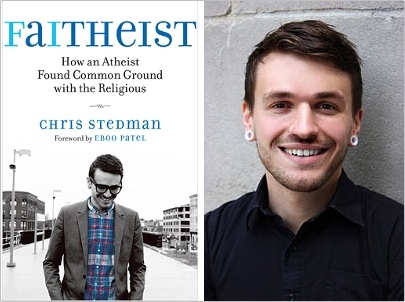 No sooner had I found a
spot in the cramped basement of an Old Jerusalem café in Central Square than I
realized I had entirely misplaced the notes and questions I had written for an
interview with Chris Stedman, author of Faitheist:
How an Atheist Found Common Ground with the Religious. My mind reeled,
trying to remember my talking points, trying to brainstorm new ones. Chris had
just arrived back in town from a cluster of speaking gigs and was already
taking time away from work to meet with me; the least I could do was ensure I
knew what I wanted to ask him. As I grabbed my notebook and began to scrawl a
few poorly-ordered questions, I looked up to see him standing before me
smiling, arms held out as if to give me a hug. (I had never met him, but
immediately doubted he was a native New Englander: as it would turn out, he is
not.) I stood to greet him, and amid his laughter about a nearly unsuccessful
attempt to find the place, I remember him glancing down at my notes to remark:
“I’m feeling
conversational today, if that’s alright with you.”
After conversing with him
for those few hours, and in the subsequent times we’ve met, I’ve realized that his
initial request—more an invitation—pretty much sums up Chris’s entire approach
to conflict-resolution: a preference for open, personal discourse as opposed to
rigid debate. In person, what’s notable about Chris is the way he becomes immediately
familiar through quirky and humbling admissions, and the forward-leaning manner
in which he listens. It’s abundantly clear that Chris is most fulfilled when he’s
creating an opportunity for both others and himself to speak with honesty.
What follows is a highly-condensed
version of some of our conversations (also found at Patrol
Magazine) in which Chris explores his transition from Evangelical
Christianity to secular humanism – as well as the various insights which have
positioned him to share about his journey.
So: let’s
be frank here. You’re 25, and you’ve already written a memoir…
[Laughing]
Ahh. More often than not, people will say to me: ‘A memoir? You must have had a really interesting life.’ I suppose I
have had an interesting life, but it’s hard for me to compare it to others
because it’s the only life I’ve ever had. Most people think their own life is
interesting, and I guess I’m no exception. But this book isn’t really about
whether my life has been sensational or not; I wrote this book because I care
about trying to improve the way that the religious and the nonreligious speak
with and about one another, because it feels to me like there is an
increasingly volatile chasm between those groups. The reason I wrote this book
as a memoir is because scholars like Marshall Ganz agree that storytelling is
one of the best avenues for reconciliation and for prompting discussion across
lines of diversity. The easiest way for me to explain why I believe this work
is urgent, and why I personally care about it so much, is by discussing it
through the lens of my own story.
Faitheist
sheds light on when you were 10 and encountered books like The Diary of
Anne Frank, Roots, and Hiroshima. How
instrumental were these books to your initial impulse to become involved in
peace-building?
I was horrified. I had no
idea I lived in a country that had recently allowed for slavery. I had no idea
that I lived in a country built on stolen land. I had no idea that, within the
last 50 years, an atomic bomb had been dropped by my own country on another. I
had no idea that WWII had happened; I knew nothing of the Holocaust. And these
books, of course, didn’t just present the facts; they were stories that personified these issues, making it easy
for me to imagine myself, or friends or loved ones, in those situations.
And how did this affect your pursuit
of a god?
Well, I was looking for a
way at a very young age of how to make sense of all that—I wondered if the
perpetrators of those crimes would be on the receiving end of some type of justice,
or if the people who had suffered at the hands of such evil individuals would
experience some kind of redemption. The Christian cosmology provided the
answers to the questions I had been asking; the theology I was presented said
that those who acted in selfish ways—ways that obscured others’ rights to live
freely in the world—would be punished for their actions, and that the innocent
individuals who suffered would be rewarded with an eternal life… if they accepted Jesus Christ as their
personal savior.
And that’s a big “if” that you
committed to, right?
Well, I wanted that for
myself too. Converting seemed like a no-brainer at the time. Everybody there
was, like, so excited for me, and I thought: okay, now I belong. Now I belong somewhere; I belong here. And not only
in this physical space, surrounded by these people, but in this sort of larger
cosmic structure. As in: “I am part of God’s flock now.”
How did people receive you?
So warmly. I remember the
youth pastor asking me, after I casually mentioned I had a big exam coming up,
“How did that math test go?” They were very attentive; they really seemed to
care—and that felt really nice, given the way my family was fracturing at the
time. Another factor that played into my going to church was that I wasn’t the
coolest kid around—I didn’t have trendy clothes and was a bit of a nerd, and
all the cool kids went to youth group.
Youth group was this weird mix of cool kids and the nerds they wouldn’t
associate with outside of youth group. But while you’re at youth group, you’re
all best friends. Anyway, despite all of those things that appealed to me about
church—the way it substituted the structure my family once provided, how it
compensated for my feeling like a total misfit at school, and how it provided me
a framework for making sense of injustice—it wasn’t a good thing for very long.
Why not?
Well,
I soon realized it was only a safe place for some. About two months into my participation in this Evangelical
Christian community, I finally put my finger on something that I had always
sort of known. I had always felt a little, um, different. And I wasn’t
altogether sure why. I mean, everybody feels a bit different at some point. But
I just knew something was ‘off.’ Something about who I was didn’t fit what I
was supposed to be.
I assume
you’re partly referring to your sexual orientation—how would you say that you
first fully recognized this “difference”?
I
write about it in the book: I was watching TV and this commercial came on. It
was a low-budget ad for swim suits; there was a male model and a female model
standing next to each other, and I just had this moment where I was like: ‘Oh my God. It’s supposed to be the one on
the left drawing my eye, but it’s the one on the right.’ It was horrifying.
I was like, ‘Oh f—. I’m in big trouble.’ Because I knew this was
going to be a big problem—not just in terms of societal expectations, but
particularly within this community that I was so enamored with, that meant so
much to me.
And you
lived in a small town in the Midwest, right?
I
grew up just outside of St. Paul, in a blue-collar river town. To put it in
perspective, my elementary school district was the one featured in a Rolling Stone article entitled “One
Town’s War on Gay Teens,” which investigated a recent suicide epidemic where
nine students thought to be gay killed themselves within a two-year period. So,
needless to say, I didn’t want to be gay. See—things are very different today.
There are representations of happy, healthy LGBT folks all over the place.
Ellen DeGeneres, Glee—they’re
everywhere you look. But when I was in middle school, I don’t think even Will & Grace was on the air yet. And
even by the time that show did come, they, you know, lived in these fancy New
York apartments with lives that didn’t look anything like mine. I was a dorky
Midwesterner—I could not relate to that. I didn’t personally know any gay
people, and the few things I had heard about gay people were not good. At the end of the day, though,
my being gay was just another way thing to make me feel different from the
majority of my peers.
How did the realization that you
were gay affect your faith?
Since I didn’t really
want to be gay, I decided I was going to change my sexual orientation. I got
the idea from my Christian church, who said that homosexuality was solvable,
changeable. I didn’t talk to anyone about it for fear of being ostracized, but
I got the impression based on ideas promoted within the church that being gay
was a spiritual affliction—one that could be overcome through dutifulness to
tradition. So if I prayed and I fasted and I studied Scripture and was just
this model Christian, my ‘burden’ would be lifted. I came to see my same-sex
attractions as a test, or a punishment—one I could overcome. So I worked very hard
to do just that, but became despondent as years passed by and I didn’t see any
progress. The irony is that I had become a part of this community because I was
looking for a way to make sense of suffering and because the communal aspect of
Christianity was very appealing—but when I became increasingly serious about my
quest to change my sexual orientation for them, I ended up retreating further
and further into myself, and suffering more and more. Eventually I was just a
zombie stumbling through my own life, completely unengaged with the world
around me; focused solely on this one
thing.
You write in the book about certain
times that you were harassed by Christians. How much did those experiences
influence your break with Evangelical Christianity?
My
atheism wasn’t born out of the negative experiences that I had had within the
church, although I will admit that they sort of set me on a course of
self-reflection that led me to the conclusion that God probably does not exist.
As a college student, I was encouraged to turn a critical eye on my initial
conversion experience. When I did, I realized I hadn’t really converted for the
theology of the church, but for the community and the ethics and the positive
social action. But I wonder if I would’ve had the opportunity to enter into
that deep kind of reflection if I hadn’t had to question everything about who I
was for a number of years. I don’t know. I actually think those kinds of
hypotheticals are a bit silly. I am where I am now, and that’s what I know. But
it’s important for me to say that I didn’t decide that I don’t believe in an
anthropomorphized deity who is an interventionist force simply because
Christians were mean to me. I feel that’s what a lot of people think about
atheists—that they don’t believe in God because of negative experiences with
religion.
Reactionary?
Exactly. Sometimes
atheism is portrayed as something that is purely reactionary. For me, it was
actually more the result of critical self-reflection, which I go into in the
book. I looked at my own underlying values and beliefs and I just decided, you
know, this community isn’t my community and this Christian narrative is not my
narrative. It’s interesting to me that when I tell a very brief version of my
story of my years in the church, I’ll have Christians come up to me afterwards,
and they’ll say: “I just want to apologize on behalf of all Christians for what
you went through and you should know that not all Christians believe this. I’m
a part of a community that would welcome you without question for who you are.”
And while I really appreciate that, and I know it’s usually coming from a very
good place, part of me wonders: ‘did you
listen to the second half of what I talked about?’ My issue with
Christianity wasn’t solely because I hadn’t been entirely welcomed, though that
was a big part of it; I had to find a place where I fit. I had to find the
right language to describe the world around me. And that right language is a
humanistic, naturalistic way of seeing things.
If
existential problems don’t concern you as much anymore, why do you feel so
strongly that the irreligious should care about religion?
I
care in the sense that other people care. I recognize the significance religion
holds for so many other people. Even though the debate about the existence of
God is increasingly irrelevant to me, that doesn’t mean that it must be
irrelevant to everybody else. I have many friends and colleagues and people who
inspire me to action who are deeply motivated by their religious beliefs—and not
only isn’t that a problem to me, I actually celebrate
it, when it’s something that enriches their lives and propels them to enrich
other people’s lives. It’s not my business to say that because their source of
inspiration is different from my own and because I believe it is incorrect,
they must abandon it. If something is
a force for good in somebody else’s life, I don’t feel that it is my place to
erode that belief.
And in
this sense, you’ve been known to deviate from the New Atheist movement.
Yes,
this is where I diverge very strongly from some other atheists. A lot of other
atheists I encounter believe that the solution to the problems in our world is
to convince other people to drop “magical thinking” as they would put it—to
look at the hard, cold facts of existence and face them in the eye and just
deal with the fact that ‘we are all we
have.’
Though
you’ve received criticism from such atheists as being “too soft” (with the
title of your book as evidence), you haven’t always been so open to the fruitful
aspects of religious belief. (After your conversion from Christianity, you
express in Faitheist
that you had been confrontational, mirroring the kind of atheism you now object
to.) What changed? What’s a key principle for you now when you’re interacting
with those who are outspokenly committed to religious beliefs that oppose your
own?
Self-awareness,
first and foremost. It sounds backwards, but focusing on myself has enabled me
to find common ground with others. I try to be increasingly aware of my own stuff: where my own pressure-points are,
when I’m engaging in an interaction with someone else and it’s really about
something that I myself am dealing with. I think self-awareness for me has been
the key for being able to find common ground with people who believe really
different things than I do, and the key to being able to forgive the people who
perpetuated the beliefs that ultimately led me into a really difficult
adolescence.
As
I write in the book, so much of my issue in college was that I really wasn’t
self-aware. So much of what was preventing me from having those conversations
with others – so much of what led me to be confrontational – was my own lack of
self-awareness, and less what they had done. I hadn’t fully acquired a
disposition which made me want to
learn and want to listen — I had this
orientation of wanting to project and disagree, or wanting to isolate myself,
and I could sort of twist what others said. I could totally manipulate anything
anyone said into something hateful. But as I got older, I shifted into a
position of wanting to understand what I cared about the most and where my
values were. A lot of that has had to do with my education in pastoral care
work—my Masters was in Pastoral Care. My focus shifted from wanting to align
the beliefs of others with my own, or wanting to confront differences, to
wanting to live as fully into my own convictions as I could.
Do you
feel religious belief can ever become a problem?
It
becomes a problem when a person’s religious beliefs compel him or her to impose
those beliefs onto other people’s lives in ways that are harmful and hurtful;
when they’re used to diminish others’ liberty and dignity. Of course, I don’t
think that religious beliefs have a monopoly on dehumanization and diminishment.
The issue for me is not religion or religious beliefs as much as it is any kind
of totalitarianistic, dogmatic, exclusivistic, tribalistic way of thinking and
way of seeing the world—anything that is used to oppressive ends. If we can
reduce the prevalence that kind of thinking and that kind of behavior, we will
live in a much more peaceable world.
Faitheist
sheds light upon both your adolescence and early adulthood, and I know that the
work you immerse yourself in – interfaith activism—involves reaching out to a
younger crowd who oftentimes feels hesitant to validate their nonreligious,
religious, and sexual-based identities due to their age. How do you hope that
younger individuals will interact with this book?
I
hope that it might encourage younger people to step out into the public arena
with their stories and their beliefs. I believe young people have the capacity
to do such good work in the world, but many don’t feel they have the authority
to speak, or to act, or to influence. This is why I’m so involved with IFYC,
because I hope that other young people will see me say: ‘You know, he’s not the
smartest guy around. He’s not the most well-spoken; sure, what he’s doing
resonates with me, but I could do what he’s doing.’ Young people’s voices are
largely absent in these circles of influence, and I hope that my experience
inspires other people to be confident, to speak out, and to not feel like they
have to have everything figured out in order to participate in discussions
about religious diversity.
As with any memoir, publishing this
puts you in a vulnerable position. How do you feel you might respond to any
criticism about “not-having-all-of-your-ducks-in-a-row” – that your life is too
much in flux to be penning it down in a memoir?
[Laughing:] I’m sure that
in 5 years from now so much will have changed, but I suspect that my central
concerns will remain relatively stable. Without being apologetic about it, I
come right out in the book and try to explain that I don’t have it all figured
out. Still, I hope my striving for authenticity will come through in the
writing, and in who I am as a person. And if that doesn’t translate, then, you
know, I’ll keep trying. What I’ve learned over the years from struggling with
all of this is that every day is a new day—a chance to try again, to try it
anew, to try something else. It’s
constantly ongoing, meaning: nothing is at the end of the book. There is no
period.
Related articles


 Beacon Broadside
Leave a comment