Aviva Chomsky is Professor of history and Coordinator of Latin American Studies at Salem State University in Massachusetts. Her many books include They Take Our Jobs! And 20 Other Myths about Immigration, and A History of the Cuban Revolution. A new book on immigration, Undocumented, is forthcoming in Spring 2014 from Beacon Press.
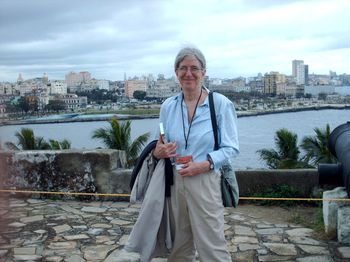
Aviva Chomsky in Havana. Photo courtesy of the author.
I’ve been traveling to Cuba
regularly since 1995, for research, to attend conferences, and to take students
on short-term study abroad trips, when those have been allowed under the
Clinton and Obama Administrations. (Such trips were prohibited under the Bush
Administrations.) I’ve published several articles in Cuban journals, mostly
about Cuba-related themes.
Last weekend, I was in Havana to
present the new Cuban edition of ¡Nos
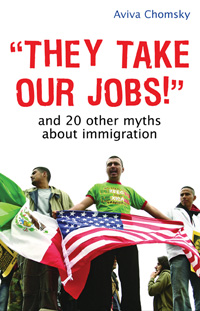
quitan nuestros empleos! (the Spanish translation of my book They Take Our Jobs!, which was published by Beacon
in 2007) at the International Book Fair in Havana.
Shortly after They Take Our Jobs! came out in English, friends in
immigrants-rights organizations told me that we needed a Spanish-language
version. It took a while to find a publisher (Haymarket Press) and even longer
to finish the translation. My Cuban friend who helped with the final editing of
the Spanish version, Alfredo Prieto, offered to help me find a publisher in
Cuba as well. He put me in touch with Fernando García of Editorial Nuevo
Milenio, who ended up bringing out the beautiful Cuban edition. I am thrilled
to have the project come to this fruition, and that I was able to be Havana for
its release.
Most often, my trips to Cuba begin
in Miami, a strange, liminal place that always seems like a good way to
transition from the United States to Latin America or vice versa. The driver of
my hotel shuttle asks me where I’m going. “Cuba,” I tell him. “You are going to
my country,” he replies. I switch to Spanish and ask him how long he’s been in
the United States. Since 1998, he tells me. “Here you work very, very, hard,”
he goes on. “I’ve lived well here, don’t get me wrong. But Cuba is my country,
and that’s where I want to live. Cuba is wonderful. It’s just the government
that’s bad, that’s ruined everything.”
Even though my flight doesn’t leave
till 9, I have to check in at 6. This is an improvement over the last time I
went, using the same charter company, Marazul Tours. Last March I was told to
arrive at the airport four hours ahead of the flight and look for an agent
wearing a blue t-shirt in Terminal G. Needless to say, there was no
blue-shirted agent anywhere to be found, and nobody answered the phone at the
several numbers I had for Marazul. Nor were there any counters that seemed
connected to our charter flight, which didn’t appear on any of the “departure”
screens. Finally a rumor reached our ears—other passengers looking for the same
blue t-shirt thought we should try Terminal D. With little else to go on, I and
my 13 students trudged over to Terminal D. Still no blue shirt, and no flight
listed on any screen, but the rumors grew thicker, and, finally, we found
ourselves at an anonymous-looking counter checking in. It was like being in
Cuba before we even left Miami—somehow you just have to figure out how to do
things that seem impossible—resolver,
as the Cubans say.
 This time, though, I arrive as
instructed with only three hours to spare. Terminal G is teeming with
blue-shirted representatives, and multiple flights to Havana are listed on
every screen. There are only two people ahead of me in line, and I am quickly
checked in. The only sign that this is not a normal flight is when I try to use
my credit card to pay the $20 to check my bag. “Sorry, we only take cash,” I am
told. The blue-shirted representative says he’ll wait for me while I run to the
ATM.
I usually try not to check my bag,
but this time I’m carrying many bottles of medicines and hand sanitizer that my
Cuban friends have requested. I’m also carrying a half pound of baker’s
chocolate—they want me to bake brownies while I’m there.
A grey-haired gentleman going
through the same lines asks if I’m with a group. No, I say, and you? “Yes, we
are a gentle group,” I hear him reply. I look around—his companions look gentle
enough, but I’m still confused—are they Quakers, or something? Then he starts
to tell me about the activities they’ll be doing in Cuba, and I realize that
they are dentists—a dental group.
By 7 I’m at the gate. I order a
cafe con leche from a nearby stand before I sit down. “Ya está dulce,” the
server tells me kindly as she hands it to me. We’re almost in Cuba—the coffee
automatically comes sweet, and in Spanish.
My seatmate on the first leg of my
journey—from Ontario, California, where I am teaching at Pomona College, to
Dallas—was a graduate student in Spanish returning home from a job interview.
I’m reading a book called Dangerous
Trade: Histories of Industrial Hazard across a Globalizing World. The third
chapter is about a mercury mine in Almadén, Spain. “That’s where my father
worked—he was a mining engineer,” she offers. When the mine closed, the town
died—now there is hardly anyone left. She came to the United States to study,
and will probably stay. Migrations and global connections are everywhere.
My seat partner on the plane to
Havana tells me that she is going back to Cuba for the first time since she
left, in 1968, at age 13. “Look, I’m trembling,” she tells me as the plane
touches down. Her grandmother left Spain for Cuba in her 30s, and returned for
the first time when she was 80. “I’m almost as bad,” she says. I’m embarrassed
to tell her that I’m going to Cuba for the publication of my book on
immigration.
If the Miami airport experience has
improved, the Havana experience has not. The line through immigration takes
over an hour, and the bags have still not appeared when I finally get through. Nobody
seems to know which of the two baggage claim areas our bags will be on. It’s
hot, noisy, and crowded, and it’s not clear where there are lines to stand in
and where we are supposed to go. Somehow, though, my suitcase appears and I
manage to pass through the required lines and exit the terminal. As always,
there is a huge crowd of excited friends and relatives waiting for people from
the Miami flights.
Every time I travel to Latin
America, I’m reminded how important, and how complicated, water is. At home, we
expect clean water to flow reliably from every pipe whenever we turn a faucet
or push a handle. Kitchen sink, bathroom sink, shower, toilets—there are so
many places where something can go wrong—assuming that there is water at all,
and that it’s not contaminated. The TV screen in the airport welcoming
travelers to Cuba flashes health warnings, one of which is (in Spanish) to
always boil your water before you drink it. This time, my friends advise me to
use boiled water to brush my teeth and to rinse dishes and vegetables in boiled
water after washing them.
Sometimes you can avoid the
foreign-tourist-in-Cuba experience of being “hustled” by staying away from
hotels and tourist sites. This time, though, I’m approached while waiting on a
busy street in Centro Habana outside my friends’ apartment. It’s 96 steps up,
and someone has to come down to unlock the street door for me. “Are you
visiting Cuba for the first time?” a young man asks me from inside a
neighboring storefront offering “economist/accounting services.” “What are you
doing here?” I’m a professor, attending the book fair, I tell him. “Oh, a
professor, what do you teach? Are you interested in economic issues?” Yes, I
say. “My friend just wrote a book on cuentapropismo,
he reveals. “I have a dozen copies at my place down the street. Do you want
one?” Maybe, I say guardedly, but I don’t have much room in my luggage. “Are
you married?” he continues without missing a beat. “I really like you. (Me caes muy bien.)” “Yes, I’m married” I
lie. “It doesn’t matter!” he exclaims. “It can be our secret dream! Nobody has
to know!”
The book fair is amazing. The main
installation is at the El Morro fort just outside the city. The parking lot is
filled with buses and cars, and walkers are flowing in as well. The many
streets inside are packed with people. Publishers’ displays are interspersed
with food stalls, children’s activity stations, and performances. There is no
security visible, and the crowds are relaxed and jovial. The only thing I can
compare it to is First Night in Boston. But here everyone has come to look at
books!
A young man approaches me after a
presentation by the sister of one of the Cuban 5, national heroes, imprisoned
in the United States on charges of espionage. They were spying on right-wing
Cuban American organizations that had planned and carried out armed attacks
against Cuba. “You probably don’t recognize me,” he says shyly. “You were
friends with my mother in 1995, when you were in Cuba with your kids. I was a
baby then, but when you left, you gave my mom the child seat from your bicycle.
I rode around in it for years.” He’s the same age as my son, in his third year
at the university.
There are multiple rooms with
concurrent book presentations going on all day, every day. Mine is at 3:00
Saturday afternoon. About 30 people fill the room. Two commentators precede me:
one describes my book in detail, and the second one gives my biography. I hope
he is around to write my obituary, because he gets it all so right: my
intellectual trajectory, my activism, my work life. It’s exactly how I want to
be remembered.
I decide to tell the audience about
four life experiences that brought me to write They Take Our Jobs!. They were experiences that opened my eyes to
the myths I had been living with, and together made me want to write a book
that would do the same for others. There’s a great word for it in Spanish: concientización. There’s no perfect
translation in English, but it’s something like consciousness-raising, or
political awakening.
The first experience was when I
left college after my first year, in 1976, to work for the United Farm Workers
in California. I was looking for something different to do, but I had no idea
what I was getting myself into. I had, of course, been eating fruits and
vegetables all my life, but as far as I knew, they came from the supermarket. It
had never occurred to me that everything I bought at the store had a history,
and that someone had to plant, care for, and harvest all of that produce. With
the farmworkers I was thrown right into the middle of a world I had no idea
existed: a world where almost everyone was Spanish-speaking and Mexican, and
where they worked long hours under harsh conditions to harvest the food we
blithely purchased in Massachusetts.
The second experience I recounted
was at UC Berkeley, where I was exposed to Chicano Studies and had the chance
to study with, and then teach for, one of the discipline’s founders, Carlos
Muñoz. The whole premise behind the Chicano Studies movement—like those that
pressed for the creation of African American and Native American studies
programs during that same tumultuous decade of the 1970s—was that existing
curriculums were basically the study of white people, and had left out the
experiences of people of color in the United States. Once again, this was an
eye-opener. All that history I had been learning all of those years, that was
an exclusive, politicized, history? There were whole histories that it had left
out? I decided to become a historian.
The third experience was when I got
to Bates College in 1990, fresh PhD in Latin American history in hand. Being in
Maine, one of the coldest and whitest states in the country, Bates had been
very slow to diversify, and its Latino student population was extremely small
and extremely new. Both students and faculty urged me to create a course on
Latino history, and I was eager to do so. A lot had changed since my Chicano
Studies days, though. Latin American immigration had skyrocketed, and it had
diversified both in its origins—including far more Caribbean, Central American,
and South American immigrants—and in its destinations, moving out of its
traditional centers in California and the Southwest. The new discipline of
Latino—rather than Chicano, or Boricua (Puerto Rican) studies—was developing. I
jumped on the bandwagon and decided I needed to become part of this new wave of
Latino history.
Finally, the experience that led
directly to They Take Our Jobs! came
in May of 2006, with the massive immigrants rights demonstrations. I
participated in a small part of the nation-wide movement, in Salem, where
immigrant-owned businesses closed and children stayed home from school on May
1, the national “day without an immigrant.”
The next day, I was in my
department office conversing with an African American colleague. Nearby, some
white students were complaining about the demonstrations. “I don’t have anything
against immigrants, only illegal immigrants. My ancestors came here legally! These
immigrants should do it the right way, following the law, like my ancestors
did.” This was a discussion I had
engaged in a million times already, and I had my response ready: Your ancestors
came here legally because they were European, and there were no legal
restrictions on European immigration at the time. But somehow, looking at my
colleague, it struck me for the first time: Only white people say that! Of
course the ancestors of most African Americans came here “legally” too—because
their enslavement was perfectly legal. But white people who are so proud that
their ancestors came legally are basically saying that they are proud to have
benefitted from white privilege.
I decided not to get into an
argument at that moment, but when I got home and opened the local newspaper,
the front-page article about the demonstrations quoted a white observer making
the same comment. It seemed more useful to compose a letter to the editor
explaining my thoughts, so I did; it was published the next day. And a few days
later an editor from Beacon Press called me saying that she had seen my letter,
and wondered whether I’d be interested in expanding it into a book. That was
the seed of They Take Our Jobs!.
The eminent Cuban historian Jorge
Ibarra attends my talk. “Whatever happened to your book on Haitian migrant
workers in Cuba?” he demands. On my first visit to the island, he had provided
invaluable help orienting me to the historiography, and the archives, relevant
to my research. “I never wrote the book,” I confess. “I published the research
I did here as an article in the Hispanic
American Historical Review, but then my work ended up moving in different
directions.” “I still have the original, typed manuscript of that article!” he
tells me proudly. “You gave it to me when you came back the next year, when you
were working on it.”
As I get ready to leave the fair,
I’m asked to sign a statement, a letter to Comandante Presidente Hugo Chávez
Frías. “The undersigned intellectuals, artists, writers, and guests who are
participating in the Twenty-second International Book Fair in Havana, from the
San Carlos Fort in La Cabaña, wish to send the President of Venezuela, Hugo
Chávez Frías, our solidarity and our commitment to accompany him day by day in
these moments of his recovery, because we know that he is carrying out a battle
and his spirit of struggles continues intact in these difficult but hopeful
moments he is living through,” the letter begins, in somewhat typical flowery
Spanish-language style. “You have succeeded in extending ties of unity to other
continents and countries besieged at this time by the twenty-first century wars
of recolonization, and you have always accompanied them with your solidarity. Dear
Comandante, you have succeeded, along with other compañeros, in achieving the uncompleted dream of Simón Bolívar,
José de San Martín, and other heroes of our independence, frustrated by another
imperial expansion that framed our dependence since the end of the nineteenth
century… You are at the forefront of this battle with your strength, courage,
and love. Adelante, Comandante, our
peoples are waiting for you.”
It sounds a lot like a song I
played for my students at Pomona last week, “Simón Bolívar,” written in the
early 1970s by the Chilean group Inti Illimani.
Simón Bolívar, Simón,
revivido en las memorias
que abrió otro tiempo la historia,
te espera el tiempo Simón.
Simón Bolívar, razón,
razón del pueblo profunda,
antes que todo se hunda
vamos de nuevo Simón.You still live in our memories,
Simón
History has opened another era
Time is waiting for you, Simón…
Before everything is lost
Let’s try again, Simón.
The letter is not written exactly
with the words I would have used, but I don’t care, it’s basically a get-well
card, and I sign it, imagining that one day David Horowitz will discover it or
the National Enquirer will splash a
headline, “Aviva Chomsky claims Hugo Chávez at ‘forefront of battle’ and calls
for him to forge ahead!” But I doubt I’m important enough for it to merit any
notice at all. And it feels like the least I can do.
Related articles


 Beacon Broadside
Leave a comment